
D1 Football Workout Program: A Comprehensive Overview
This detailed guide outlines year-round D1 football training, essential for maximizing performance throughout a rigorous season. It encompasses strength, power, and plyometrics,
providing sample weekly schedules for both in-season and off-season periods, alongside injury prevention and nutritional guidance.
Understanding the Demands of D1 Football Training

Division I football presents an unparalleled athletic challenge, demanding a holistic training approach far exceeding high school programs. Collegiate strength and conditioning are significantly more rigorous, technical, and advanced, requiring athletes to possess a superior strength profile demanded by D1 coaches.
The physical demands necessitate year-round dedication, encompassing not only intense weight training – often 4+ times weekly in-season – but also comprehensive field work focused on developing elite speed, agility, and explosive power. A successful D1 program isn’t solely about lifting; it’s about translating strength into functional athleticism.
Furthermore, recovery and nutrition are paramount, as athletes must consistently rebuild and refuel to withstand the constant physical stress. Simply put, D1 football requires a complete commitment to physical preparation, extending far beyond the playing season.
The Importance of Year-Round Training
Elite D1 football performance isn’t achieved during the season alone; it’s the culmination of a meticulously planned, year-round training regimen. Unlike high school programs where off-season training often lacks structure, collegiate athletes require consistent, progressive overload to continually improve.
This continuous approach prevents detraining and allows for focused development in specific areas – hypertrophy and strength endurance in the early off-season, transitioning to maximal strength and then power development. A well-structured program builds a foundation of strength, speed, and agility that can be maintained, even under the stress of a demanding season.
Ignoring the off-season creates a significant disadvantage, as competitors are consistently building while others plateau. Year-round commitment is non-negotiable for aspiring D1 athletes.
Off-Season Training: Building a Foundation
The off-season is critical for developing a robust physical base, focusing on strength, power, and addressing weaknesses before the demands of the season begin.
Phase 1: Hypertrophy & Strength Endurance (Weeks 1-4)
This initial phase prioritizes building muscle mass and improving muscular endurance, establishing a solid foundation for subsequent strength gains. Training focuses on higher repetition ranges – typically 8-12 reps per set – with moderate weight. The goal isn’t maximal strength at this stage, but rather increasing the size of muscle fibers and their capacity to withstand fatigue.
Exercises should emphasize compound movements like squats, deadlifts, bench press, and overhead press, alongside accessory work targeting specific muscle groups. Volume is moderately high, with multiple sets per exercise. Proper form is paramount to prevent injury during this foundational period. Collegiate programs are more rigorous, so expect a demanding schedule. Recovery is also crucial; adequate sleep and nutrition are essential for muscle growth and repair.
Phase 2: Maximal Strength (Weeks 5-8)
Following the hypertrophy phase, the focus shifts to developing maximal strength – the ability to exert the greatest possible force. This phase utilizes lower repetition ranges, typically 3-5 reps per set, with significantly heavier weight. The emphasis is on lifting as much weight as possible while maintaining proper form. Compound lifts remain central, but with increased intensity and reduced volume compared to Phase 1.
Technique refinement is critical during this phase to ensure safety and maximize force production. Collegiate strength programs are technical and advanced, demanding precision. Incorporate variations of core lifts, like front squats or incline bench press, to address weaknesses. Adequate rest between sets (2-3 minutes) is vital for recovery and performance. Nutrition plays a key role in supporting muscle recovery and strength gains.
Phase 3: Power Development (Weeks 9-12)
This final off-season phase transitions from strength to power – the ability to exert force quickly. Power development combines strength and speed, crucial for explosive movements on the field. Training incorporates Olympic lifts (cleans, snatches, jerks) and variations, alongside plyometrics and explosive variations of traditional strength exercises. Repetition ranges are typically lower (1-3 reps) with a focus on bar velocity.
The goal is not maximal weight, but maximal speed with a challenging weight. Proper technique is paramount to prevent injury. This phase builds upon the strength foundation established in Phases 1 and 2. Field work drills, developing elite speed and agility, are integrated. Collegiate programs are rigorous, demanding advanced techniques. Recovery is crucial, allowing the nervous system to adapt to the high-intensity training.

In-Season Training: Maintaining Strength & Power
In-season training prioritizes maintaining strength and power developed during the off-season, preventing detraining while managing fatigue. Adjustments focus on volume and intensity.
Weight Training Adjustments During the Season
During the competitive season, the primary goal of weight training shifts from building maximal strength to maintaining the gains achieved during the off-season and power phases. This necessitates significant adjustments to training volume, intensity, and exercise selection. Collegiate programs recognize the increased physical and mental demands placed on athletes during gameplay, and therefore, reduce overall lifting volume to mitigate fatigue and minimize the risk of overtraining.
Typically, the frequency of weight training sessions is decreased, often from 3-4 times per week in the off-season to 2-3 times per week during the season. Intensity is also modulated, with a greater emphasis on maintaining strength levels rather than pushing for new personal records. Exercises are often modified to focus on explosive movements and functional strength, directly translating to improved performance on the field. Recovery becomes paramount, with careful attention paid to nutrition, hydration, and active recovery strategies.
Focus on Explosive Movements & Speed
Maintaining and enhancing explosive power and speed are critical during the in-season phase of a D1 football program. Training shifts towards exercises that directly translate to on-field performance, prioritizing rate of force development over maximal strength gains. This includes incorporating plyometrics, Olympic lifts (with reduced volume and emphasis on technique), and sprint work into the weekly schedule.
Speed drills become more specific to football movements, focusing on acceleration, agility, and change-of-direction skills. These drills are often integrated with football-specific conditioning to simulate game-like scenarios. Weight training exercises are selected to complement these speed and power development activities, emphasizing exercises like power cleans, snatches, and jump squats. The goal is to maintain the athlete’s explosive capabilities while minimizing fatigue and maximizing recovery, ensuring peak performance during competition.

Key Components of a D1 Football Workout
A comprehensive D1 football workout integrates strength training, plyometrics, and agility drills. These elements build a foundation for explosive power, speed, and stability.
Strength Training Exercises
Strength training is paramount in a D1 football program, demanding rigorous and technical approaches beyond high school levels. Collegiate programs emphasize consistent, advanced lifting regimens; Lower body exercises, such as squats (back, front, goblet), deadlifts (conventional, sumo, Romanian), lunges, and plyometric variations, are crucial for developing leg power and overall strength.
Upper body work focuses on bench press (flat, incline, decline), overhead press, rows (barbell, dumbbell), pull-ups, and various pressing/pulling movements to build upper body strength and power. Core strength and stability are equally vital, incorporating exercises like planks, Russian twists, medicine ball throws, and anti-rotation presses. These exercises enhance athletic performance and reduce injury risk.
Lower Body Strength Exercises
Developing explosive lower body power is fundamental for D1 football athletes. Key exercises include variations of squats – back squats, front squats, and goblet squats – to build overall leg strength and muscle mass. Deadlifts, encompassing conventional, sumo, and Romanian variations, are essential for posterior chain development, crucial for power generation.

Lunges, both forward and reverse, enhance unilateral strength and stability, mimicking game-time movements. Plyometric exercises, such as box jumps and depth jumps, build explosive power. These are often combined with weighted variations to further challenge athletes. Consistent progression and proper form are vital to maximize gains and minimize injury risk within the program.
Upper Body Strength Exercises
A robust upper body is critical for blocking, tackling, and throwing in D1 football. Bench press variations – flat, incline, and decline – are foundational for developing pressing strength. Overhead press builds shoulder strength and stability, vital for overall upper body power. Pull-ups and chin-ups enhance pulling strength, crucial for functional movements.
Rows, including barbell rows, dumbbell rows, and cable rows, target the back muscles, contributing to posture and power. Exercises like push-ups and dips build foundational strength and endurance; Rotational exercises with medicine balls or cables improve core stability and explosive power transfer. Proper form and progressive overload are paramount for maximizing results and preventing injuries.
Core Strength & Stability
A strong core is the foundation of athletic performance in D1 football, enhancing power transfer and injury prevention. Planks – standard, side, and variations – build isometric core strength and endurance. Russian twists with or without weight develop rotational core power, crucial for tackling and changing direction.
Hanging leg raises and knee raises target the lower abdominal muscles, improving hip flexor strength. Medicine ball slams and wood chops enhance explosive core power and coordination. Anti-rotation presses with resistance bands challenge core stability against rotational forces. Incorporating these exercises improves balance, posture, and overall athletic performance, minimizing injury risk during intense gameplay.
Plyometrics for Explosive Power
Plyometrics are vital for developing the explosive power demanded in D1 football, improving jump height, sprint speed, and agility. Box jumps – varying heights – build lower body power and reactive strength. Depth jumps enhance the stretch-shortening cycle, maximizing power output. Single-leg hops and bounds improve unilateral power and balance.
Medicine ball throws – overhead, chest pass, rotational – develop upper body explosive power. Cone drills incorporating plyometric movements improve agility and change-of-direction speed. Proper technique and progressive overload are crucial to prevent injuries. Integrating plyometrics into the program enhances athletic performance and prepares athletes for the dynamic demands of the game.
Agility and Speed Drills
Developing exceptional agility and speed is paramount for D1 football athletes, requiring a multifaceted drill program. Cone drills – including the 5-10-5 shuttle and L-drill – enhance change-of-direction speed and agility. Ladder drills improve footwork, coordination, and quickness. Sprint variations – short sprints, resisted sprints, and acceleration drills – build linear speed.
Reactive agility drills, incorporating coach cues or visual stimuli, improve decision-making and reaction time. These drills simulate game-like scenarios, enhancing athletes’ ability to react and move efficiently. Proper form and technique are essential for maximizing effectiveness and minimizing injury risk. Consistent implementation of these drills translates to improved on-field performance.

Nutrition for D1 Football Athletes
Optimal nutrition fuels performance and recovery; a D1 program emphasizes macronutrient balance, hydration, and strategic meal timing. Fueling demands require a tailored approach.
Macronutrient Breakdown
For D1 football athletes, a precise macronutrient ratio is paramount for supporting intense training demands and optimizing recovery. Carbohydrates should constitute approximately 50-60% of total caloric intake, providing the primary fuel source for high-intensity workouts and replenishing glycogen stores. Protein intake should range from 25-30%, crucial for muscle repair, growth, and overall recovery from strenuous activity.
Healthy fats, comprising 20-25% of the diet, are vital for hormone production, nutrient absorption, and maintaining overall health. Prioritizing complex carbohydrates like whole grains, fruits, and vegetables over simple sugars is essential. Lean protein sources, such as chicken, fish, and beans, should be favored. Incorporating healthy fats from avocados, nuts, and olive oil supports optimal bodily functions. Individual needs may vary based on position, training intensity, and metabolic rate, necessitating personalized nutritional plans.
Hydration Strategies
Maintaining optimal hydration is non-negotiable for D1 football athletes, directly impacting performance, recovery, and injury prevention. Athletes should proactively hydrate throughout the day, not just during and after training sessions. A general guideline is to consume at least one gallon of water daily, adjusting based on individual sweat rates and environmental conditions.
Electrolyte-rich beverages can be beneficial, particularly during prolonged or intense workouts, to replenish sodium, potassium, and other minerals lost through sweat. Monitoring urine color – aiming for a pale yellow hue – provides a simple indicator of hydration status. Avoiding sugary drinks and excessive caffeine is crucial, as they can contribute to dehydration. Implementing a hydration schedule, including pre-, during-, and post-workout fluid intake, ensures consistent hydration levels and supports peak athletic performance.
Injury Prevention & Recovery
Prioritizing robust warm-up routines, consistent cool-downs, and dedicated mobility/flexibility work is vital for minimizing injury risk and accelerating recovery.
Warm-up and Cool-down Routines
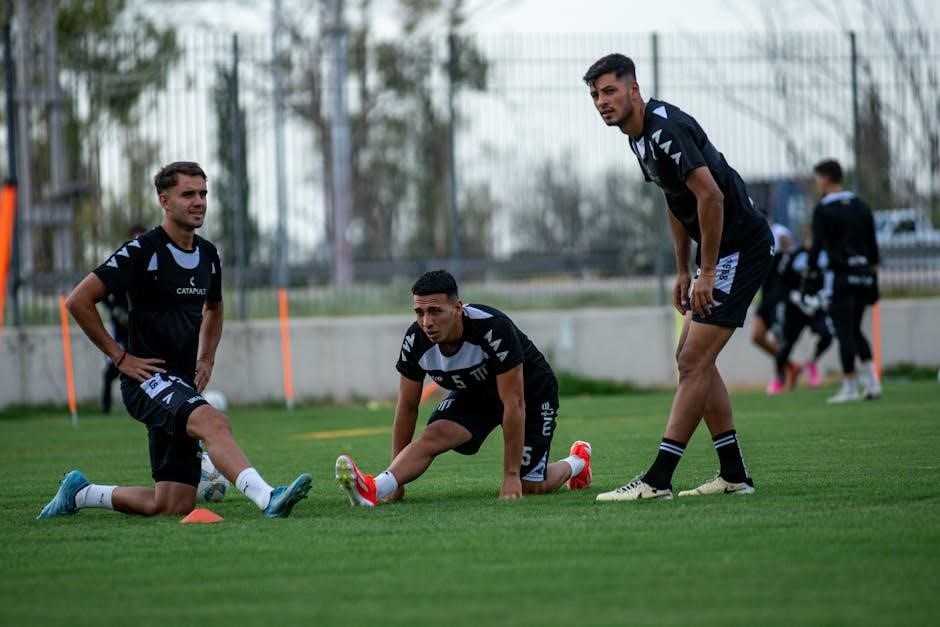
Dynamic warm-ups are crucial before each training session, preparing muscles and joints for intense activity. These should include movements like leg swings, arm circles, torso twists, and high knees, progressively increasing intensity. A proper warm-up enhances performance and reduces injury risk by improving blood flow and muscle elasticity.
Cool-down routines are equally important, aiding in recovery and reducing muscle soreness. Static stretching, holding each stretch for 20-30 seconds, should be incorporated post-workout. Foam rolling can also be beneficial for releasing muscle tension and improving flexibility. Consistent implementation of these routines is non-negotiable for D1 athletes, ensuring longevity and optimal performance throughout the demanding season.
Mobility and Flexibility Exercises
Maintaining optimal mobility and flexibility is paramount for D1 football athletes, directly impacting performance and injury prevention. Dedicated sessions focusing on joint range of motion are essential, incorporating exercises like hip flexor stretches, hamstring stretches, and shoulder dislocations with a band.
These exercises enhance movement efficiency and reduce the risk of strains and tears. Regular foam rolling targeting major muscle groups – quads, hamstrings, calves, and back – further improves tissue quality and flexibility. Prioritizing these routines alongside dynamic warm-ups and static cool-downs creates a holistic approach to physical preparation, ensuring athletes can withstand the physical demands of the sport and maintain peak performance levels.

Sample Weekly Workout Schedule (Off-Season)
The off-season program is structured around three phases: hypertrophy, maximal strength, and power development. Monday focuses on lower body strength (squats, deadlifts), Tuesday is upper body (bench press, rows), and Wednesday is dedicated to plyometrics and agility drills. Thursday mirrors Monday, but with variations in exercises.
Friday is reserved for Olympic lifting and explosive power work, while Saturday includes a lighter recovery session with core work and mobility. Sunday is a complete rest day. Volume gradually increases during the hypertrophy phase, then decreases with increased intensity during maximal strength and power phases. This progressive overload ensures continuous adaptation and prepares athletes for the demands of the upcoming season.
Sample Weekly Workout Schedule (In-Season)
The in-season program prioritizes maintaining strength and power while minimizing fatigue. Monday focuses on lower body power (power cleans, jump squats) with reduced volume. Tuesday is upper body strength and power (explosive bench press variations, pull-ups). Wednesday is a lighter recovery day with core stability and mobility work.
Thursday mirrors Monday, focusing on maintaining lower body explosiveness, while Friday is dedicated to upper body maintenance. Saturday includes light conditioning and recovery, and Sunday is a complete rest day. The emphasis shifts from building strength to preserving it, with a focus on explosive movements and speed to enhance game-day performance. Volume is significantly reduced to prevent overtraining.